Brand tracking survey: a practical guide for UK marketers
Discover how to leverage a brand tracking survey to monitor consumer perceptions and boost your brand's performance over time.

Brand tracking survey: a practical guide for UK marketers
A brand tracking survey is a repeated measurement programme that collects data on how consumers perceive, recall, and engage with a brand over time. Unlike a one-off study, it generates longitudinal brand data across successive waves, making it possible to detect shifts in awareness, usage, and loyalty before they become crises. The core value is comparison: each wave benchmarks against the last, revealing whether your marketing investment is moving the needle or quietly losing ground.
A well-constructed brand health survey does several things at once:
Tracks changes in brand awareness, usage, perception, and purchase intent across time
Provides early warning of brand erosion or competitive encroachment
Measures the uplift from specific advertising campaigns by comparing pre- and post-campaign waves
Establishes a benchmark for market positioning analysis against competitors
Supports marketing ROI conversations with evidence rather than assumption
What core metrics should a brand tracking survey measure?
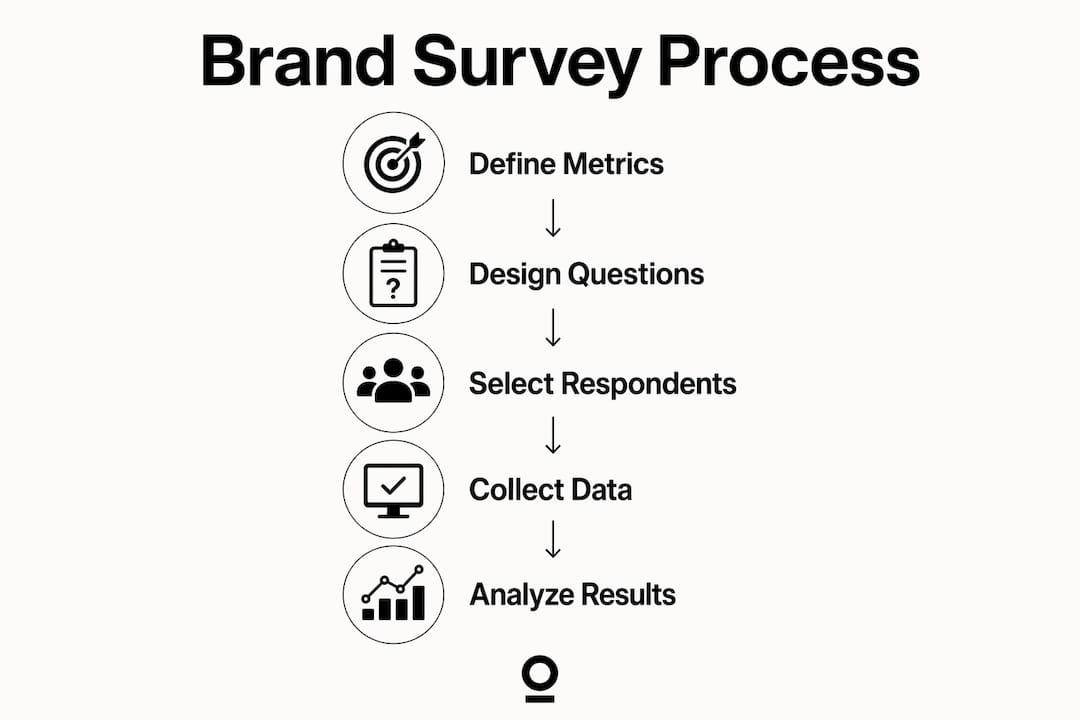
The strongest programmes focus on a manageable set of brand health KPIs rather than attempting to measure everything at once. Four categories form the backbone of most trackers.
Brand awareness: Split into unaided (spontaneous recall without prompting) and aided (recognition when the brand name is shown). Unaided awareness is the harder metric to shift and the more revealing one.
Brand usage: How frequently consumers purchase or interact with the brand, including recency and occasion data.
Brand attributes and perception: Agreement ratings against specific image statements, personality associations, and quality perceptions. These reveal whether your positioning is landing as intended.
Purchase intent and loyalty: Future purchase likelihood, preference over alternatives, and Net Promoter Score. Together, these signal the commercial health of the brand.
Consistency in how each metric is defined and measured matters as much as the metrics themselves. Changing a question mid-programme introduces noise that makes wave-on-wave comparison unreliable.
What do effective brand tracking survey questions look like?
The questions below illustrate how each metric category translates into survey language. Wording should remain identical across every wave.

Metric category | Example question | Format |
|---|---|---|
Unaided awareness | “Which brands come to mind when you think of [category]?” | Open text |
Aided awareness | “Have you heard of [Brand X]?” | Binary yes/no |
Brand perception | “To what extent do you agree: [Brand X] is trustworthy?” | 5-point Likert scale |
Usage | “Have you purchased [Brand X] in the last three months?” | Binary yes/no |
Purchase intent | “How likely are you to purchase [Brand X] in the next six months?” | 5-point Likert scale |
Campaign recall | “Have you seen any advertising for [Brand X] recently?” | Binary with follow-up |
A few principles govern question design. Leading or double-barrelled questions corrupt the data. Scales must stay consistent: switching from a 5-point to a 7-point scale mid-programme is the equivalent of changing the ruler mid-measurement. Survey length also affects quality; beyond a certain point, respondent fatigue degrades the reliability of later answers, so prioritise the metrics that directly serve your strategic objectives.
Pro Tip: Add a small “flexi-section” of rotating questions to each wave for topical issues, keeping the core questions entirely untouched. This gives you agility without compromising longitudinal integrity.
Who should you survey, and how often?
Respondent selection shapes the reliability of every insight a tracker produces. For B2C programmes in the UK, samples typically balance on age, gender, region, and socioeconomic group to reflect the national population or a defined target segment. B2B trackers balance on industry sector, company size, and job function. Brand Research, an MRS-member and ICO-certified fieldwork agency, uses multi-channel recruitment across social media, online panels, and face-to-face methods to reach representative samples across both contexts.

Maintaining consistent panel quotas wave over wave prevents statistical noise from distorting trend data. Well-run programmes keep demographic balancing within tight tolerances of their targets, and any variance beyond that tolerance should be investigated before reporting.
On frequency, quarterly tracking is the most common cadence for brands in moderately competitive markets. Key considerations:
Quarterly: Captures seasonal shifts and campaign effects; the most practical balance of cost and insight frequency
Continuous: The gold standard for fast-moving markets; data collected daily or near-daily allows precise attribution to specific campaigns or events
Semi-annual or annual: Appropriate for stable, established brands in low-volatility sectors, though anything less frequent than three times a year makes it difficult to attribute changes to specific causes
Wave-based vs. continuous: Wave-based programmes are more cost-effective; continuous programmes provide finer granularity but require greater investment in data infrastructure
Leading UK providers for brand tracking surveys
The UK market has a strong cluster of specialist research firms, each with distinct capabilities. Brandsand works alongside these providers to translate survey findings into brand strategy and creative direction.
Provider | Core specialism | Notable credentials |
|---|---|---|
Vision One Research | Brand tracking, consumer and B2B research, UK and international | Award-winning; UK and global client base |
Large-scale brand tracking, public opinion, B2C and B2B data | Global data and analytics group; extensive UK panels | |
Survey software platform, sentiment analysis, open-text analysis | Rated 4.6/5 on G2; UK’s leading feedback platform | |
Brand Research | Fieldwork and respondent recruitment, B2B and consumer | MRS member, ICO certified |
Brandspeak Limited | Qualitative, quantitative, ethnography, neuromarketing | Operating since 2004; public and private sector clients |
Mackman Research | Customer research, NPS surveys, B2B satisfaction, social sector | MRS Company Partner accreditation |
Trends Research Ltd | SME surveys, brand tracking, PR-led research | UK’s specialist SME research company |
How do you build a longitudinal survey methodology?
Longitudinal integrity is what separates a genuine brand tracker from a series of disconnected surveys. The methodology must be fixed before the first wave launches, because retroactive changes are almost impossible to correct without breaking comparability.
Start by locking the core questionnaire: every question, scale, and response option that will be tracked over time. Document the demographic quotas and the panel source. If you change the panel provider mid-programme, you introduce a confounding variable that cannot be fully controlled for, because different panel companies recruit differently and their respondents behave differently. The same logic applies to question wording: even a single changed word can shift responses in ways that look like a genuine brand movement but are purely methodological artefacts.
Build a reporting cadence into the programme design from the outset. An always-on dashboard works well for continuous trackers, giving brand managers near-real-time visibility. Wave-based programmes benefit from a post-wave analysis presentation followed by an annual strategic deep-dive using the full year’s aggregated dataset, which provides a larger base for segmentation and trend analysis.
How should you analyse and interpret brand tracking data?
Raw wave-on-wave numbers rarely tell the full story on their own. The first step is to calculate the margin of error for each key metric at each wave, because a movement that falls within the margin of error is not statistically meaningful, regardless of how it looks on a chart. Movements that consistently trend in one direction across multiple waves carry far more weight than a single-wave spike.
Segment the data by the demographic and firmographic variables you balanced on. A headline awareness figure of, say, 45% may mask the fact that awareness among your primary growth segment has declined while awareness among a less commercially valuable group has risen. That distinction changes the marketing response entirely. Look for divergence between awareness and purchase intent, which often signals a perception problem that advertising alone cannot fix.
How do brand tracking results integrate with other marketing data?
Survey data captures attitudes; it does not capture behaviour. The most complete picture of brand health comes from blending multiple data sources, including social listening, branded search volume, share of voice, CRM sales data, and website analytics. When survey-measured purchase intent rises but CRM conversion rates stay flat, the gap points to a friction point in the customer journey rather than a brand perception problem.
Connecting marketing measurement frameworks to your tracker output helps attribute commercial outcomes to brand investment. Branded search volume, for instance, tends to move in parallel with aided awareness, providing a behavioural corroboration of what the survey is reporting. Social listening adds unfiltered, real-time consumer sentiment that surveys, by their structured nature, cannot fully capture.
What are the most common pitfalls in brand tracking surveys?
The most damaging errors tend to be methodological rather than analytical. Changing question wording, scales, or panel sources mid-programme is the single most common cause of unreliable trend data. A brand team that switches from a 5-point to a 10-point satisfaction scale at wave three has effectively started a new study.
Other pitfalls worth guarding against:
Tracking too infrequently: Annual-only tracking makes it nearly impossible to attribute changes to specific campaigns or market events
Over-indexing on a single metric: NPS, for example, has well-documented reliability limitations as a standalone brand health measure; it works better as one signal among several
Ignoring the margin of error: Reporting a two-point movement as a trend when it falls within statistical noise misleads stakeholders and erodes confidence in the programme
Neglecting competitor tracking: A brand’s scores only have meaning relative to the competitive set; tracking your brand in isolation misses the market context entirely
Which tools and platforms work well for UK brand tracking?
SmartSurvey is the most prominent UK-built survey platform, offering advanced survey creation, sentiment analysis, and open-text analysis tools suited to brand tracking administration. It provides a free entry tier with paid plans for larger programmes, and its high user satisfaction ratings on platforms like G2 reflects consistent user satisfaction.
For programmes that require large, nationally representative UK panels, YouGov provides both the research infrastructure and the analytical capability within a single engagement. Vision One Research offers a full-service alternative for brands that want strategic interpretation alongside fieldwork. For SME-focused tracking, Trends Research Ltd specialises in the UK SME market and PR-led research, a combination that suits brands seeking both insight and communications-ready data. Platforms that support marketing KPI tracking alongside survey data help connect brand metrics to broader commercial performance reporting.
Key takeaways
A brand tracking survey delivers reliable insight only when its methodology, questions, and sample remain consistent across every wave.
Point | Details |
|---|---|
Longitudinal consistency | Lock questions, scales, and panel sources before wave one; any mid-programme change breaks comparability. |
Four core metric areas | Awareness, usage, brand attributes, and purchase intent form the foundation of any brand health survey. |
Survey frequency | Quarterly tracking suits most UK brands; continuous tracking is the gold standard for fast-moving markets. |
Blend data sources | Combine survey findings with social listening, branded search volume, and CRM data for a complete picture. |
Use specialist UK providers | Firms such as Vision One Research, YouGov, Brandspeak Limited, and Mackman Research bring accredited expertise to UK brand tracking programmes. |
Brand clarity does not happen by accident. At Brandsand, we work with marketing teams to translate brand tracking findings into purposeful strategy and creative direction, so that the data you collect becomes the foundation for decisions that actually move a brand forward.