Brand photoshoot planning: the complete UK business guide
Master brand photoshoot planning with our comprehensive UK guide. Build a strategic shot list and ensure your images deliver results.

Brand photoshoot planning: the complete UK business guide
Good brand photoshoot planning is marketing-led and front-loaded. The single most useful thing you can do right now is build a shot list tied directly to your marketing calendar, before you book a photographer or scout a single location. Brands & Co works with UK businesses on exactly this: a planning checklist that locks in objectives, deliverables and creative direction before the shoot day, plus clear guidance on image licensing and usage rights so every asset you commission is actually usable. Front-loaded pre-production is what separates a folder of pretty pictures from six months of campaign-ready content.
Table of Contents
What does a proper brand photoshoot planning checklist look like?
What timeline and budget should UK businesses plan for?
How do you write a creative brief, shot list and call sheet?
Who do you need on the shoot team?
Locations, permits and insurance across the UK
Wardrobe, styling and props: keeping imagery consistent
Image rights, model releases and licensing: what UK businesses must know
How to run an efficient shoot day
Post-production, file delivery and asset library organisation
How agency planning changes outcomes: a Brands & Co perspective
Key takeaways
A note from Brands & Co on how we approach photoshoots
How Brands & Co can help you commission a full-service shoot
Useful sources and further reading
What does a proper brand photoshoot planning checklist look like?
The bulk of the work happens before the camera is booked. Here is an agency-grade pre-shoot checklist:
1–2 weeks before
Map every use case: website pages, paid ads, social formats (feed, Stories, LinkedIn), email headers, print collateral
Build a content calendar and work backwards to identify which shots are needed by which date
Create a mood board and brand style brief; share reference images with your photographer so there is a shared visual language before anyone steps on set
Develop a must-have / nice-to-have shot list with orientation notes (horizontal for banners, vertical for Stories) and crop guidance for each use
Confirm talent, wardrobe, props and a named point person from your team who can make creative calls on the day
3–5 days before
Photographer scouts or reviews the space for light and background control; natural light shifts significantly across a shoot day and affects consistency
Finalise the shooting schedule and share it with every stakeholder
Send a short preparation guide to all talent covering wardrobe, grooming and arrival time; doing this at least one week before an organisational portrait session measurably improves photo quality and reduces day-of anxiety
Confirm logistics: space access, power sockets, parking, load-in windows and a contingency plan for bad weather or late arrivals
Pro Tip: A detailed pre-shoot checklist and mood board can significantly increase your usable-image count compared with arriving unprepared. That multiplier is the difference between one campaign’s worth of content and a full quarter’s library.

What timeline and budget should UK businesses plan for?
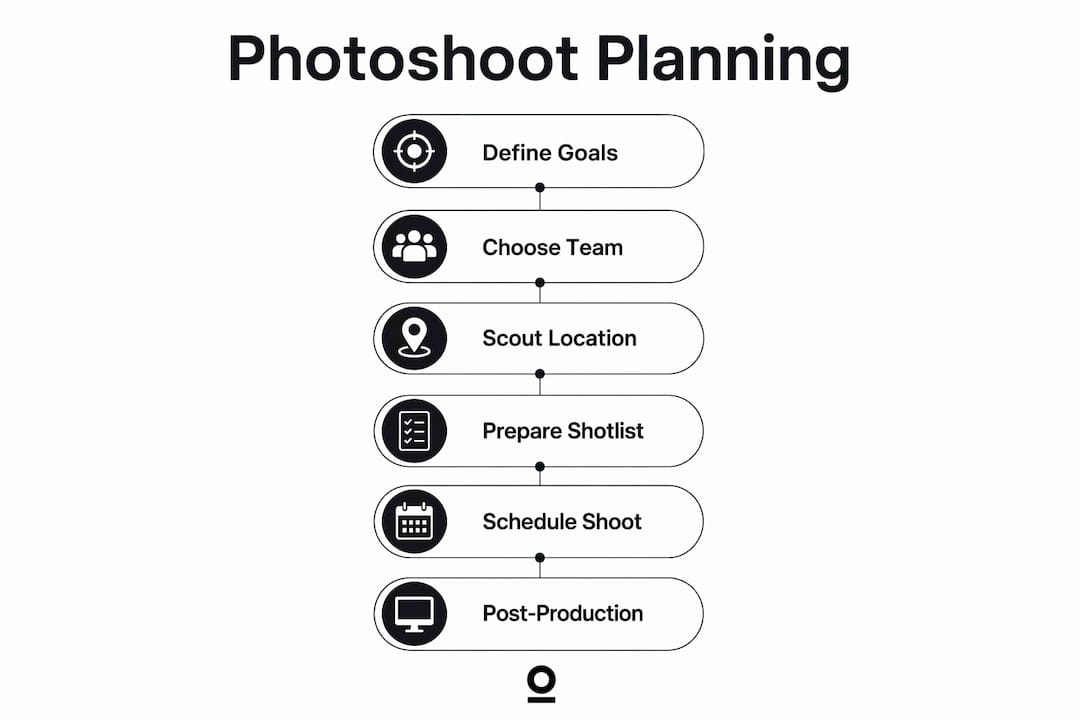
Pre-production typically runs two to four weeks for a half-day branded shoot and four to six weeks for a full campaign. That window covers the initial brief, location recce, casting, wardrobe sourcing and scheduling.
Shoot scope | Typical UK cost range | What is included |
|---|---|---|
Executive headshots (half-day) are offered at typical market rates in the UK | Photographer, basic retouching, web-ready files | |
Half-day branded shoot rates vary according to scope and services included | Photographer, art direction, location, retouching, usage licence | |
Full-day campaign shoots reflect a wide range of pricing dependent on crew and production scale | Full crew, stylist, producer, location, retouching, extended usage |
These ranges reflect typical UK market rates and vary by crew size, location hire, retouching depth and usage scope. Usage licensing is the line item most buyers underestimate. A one-year UK-only digital licence costs significantly less than a three-year worldwide licence covering paid media. Agree the scope in writing before the shoot, not after.
For team portrait sessions, allocate time per person sufficient for wardrobe checks and posing direction to maintain consistency and flow across large groups. Gallery delivery for a standard shoot typically runs within a couple of weeks; rush edits attract a premium.
How do you write a creative brief, shot list and call sheet?
A focused creative brief is the difference between “nice photos” and images that directly fulfil your marketing objectives.
Creative brief: core fields
Objective: what business problem does this shoot solve?
Audience: who will see these images and on which channels?
Tone: three to five adjectives that describe the desired feel
Primary use cases and mandatory brand elements (logo lockups, colour palette, typography)
Shot list template
Shot type | Orientation | Priority | Notes |
|---|---|---|---|
Homepage hero | Horizontal | Must-have | Negative space left for text overlay |
Product in use | Both | Must-have | Show hands, avoid chipped nails |
Team interaction | Horizontal | Must-have | Natural, not posed |
Detail / texture | Square | Nice-to-have | Background for email headers |
Individual portraits | Vertical | Must-have | Consistent backdrop and lighting |
Call-sheet essentials: timing, full contact list, arrival instructions, parking and load-in details, health and safety notes, nearest A&E, contingency contacts and a weather plan if shooting outdoors.
Attach reference images, wardrobe guidance and a prop list to the call sheet so there are no surprises on the day. Visual storytelling works best when every prop and background choice is deliberate, not improvised.
Pro Tip: Include crop and orientation notes on every shot list entry. Your design team will need horizontal crops for web banners and vertical for paid social. Capturing both on the day costs nothing; reshooting costs everything.
Who do you need on the shoot team?
Role | What they do | When you need them |
|---|---|---|
Photographer | Captures, directs and delivers final images | Every shoot |
Art director | Holds the brand vision and approves each setup | Half-day and above |
Producer | Manages logistics, schedule and crew | Full-day campaigns |
Stylist | Wardrobe, props and on-set dressing | Styled or campaign shoots |
Retoucher | Post-production editing and colour grading | All shoots |
Talent coordinator | Manages models or employee participants | Multi-person shoots |
A full-service agency handles all of these roles under one brief, which removes the coordination overhead and keeps the creative vision consistent. Assembling freelancers yourself is cheaper on paper but adds significant project management time and increases the risk of misaligned expectations.
Questions to ask at proposal stage: What does the usage licence cover? Who owns the raw files? What is the turnaround time for first proofs? Is public liability insurance included? What happens if a key crew member cancels?
Red flags: vague deliverable descriptions, no mention of usage rights, portfolios that show only one visual style, and proposals with no retouching line item.
Locations, permits and insurance across the UK
Location assessment checklist
Natural light quality and direction at the planned shoot time
Background control: can you clear the frame of distractions?
Power access for lighting rigs
Parking and load-in access for equipment
Noise levels and peak-hour constraints
For public spaces in UK cities, you will typically need a filming or photography permit from the relevant local council. Requirements vary: the City of London, Transport for London and most metropolitan councils have their own permit processes and fees. Private venues require written permission from the owner, and some carry restrictive covenants that limit commercial photography.
Insurance requirements to request from suppliers
Public liability: minimum £2 million, ideally £5 million
Employer’s liability: legally required if the photographer employs anyone on the day
Equipment cover: replacement value of all hired or owned gear
Producer’s insurance: covers cancellation, postponement and third-party claims
Pro Tip: Scout the location at the same time of day as your planned shoot. A space that looks perfect at 10am can be harsh and backlit by noon. This one visit saves hours of remedial lighting work on the day.
Wardrobe, styling and props: keeping imagery consistent
Wardrobe choices either reinforce your brand or undermine it. Solid colours photograph cleanly; small patterns and fine checks create a moiré effect on camera. Avoid logos on clothing unless they are your own. Bring 1–2 extra outfits per time block for flexibility.
Wardrobe and styling checklist
Align colour palette with brand guidelines; avoid colours that clash with the set
Steam all garments the day before; bring a travel steamer on the day
Schedule hair and make-up at least 45 minutes before the first shot
Include a touch-up kit: powder, lint roller, safety pins, clear nail varnish
Brief talent on grooming requirements in the preparation guide sent the week before
Props should tell a story, not fill a frame. A laptop, a notebook, a product in use: these give images context and extend the shot library without looking staged. Leave negative space in some compositions so your design team can overlay text for ads and web banners.
Pro Tip: Shoot every key setup in both horizontal and vertical orientations. You will need both across different platforms, and capturing them on the day costs nothing extra.
Image rights, model releases and licensing: what UK businesses must know
Usage rights are a commercial and legal matter, not an afterthought. In the UK, the photographer retains copyright by default unless a full assignment is agreed in writing.
Key licensing terms
Term | What it means |
|---|---|
Assignment | Full transfer of copyright to the client |
Exclusive licence | Client has sole rights for agreed scope and duration |
Non-exclusive licence | Photographer may licence the same images to others |
Per-use pricing | Fee increases with each additional channel or territory |
Model release essentials: every identifiable person in a commercial image requires a signed release. The release must specify the individual’s identity, the scope of use (advertising, editorial, social media), territory (UK only or worldwide), duration and any exclusivity clauses. Store signed releases with your marketing or HR records alongside the photographer’s setup sheet.
Red flags in contracts: no explicit usage scope, rights that expire after 12 months with no renewal option, and clauses that allow the photographer to use your images in their own advertising without your approval.
How to run an efficient shoot day
A well-structured day keeps the shoot creative rather than devolving into logistics negotiations.
Photographer and crew arrive 30 minutes before talent for lighting setup and a walkthrough of the space.
Brief the full team on the shot list and day schedule before the first frame is captured.
Shoot hero images first, when energy and styling are at their freshest.
Alternate between group setups and detail shots to maintain momentum and give talent natural breaks.
Run a quick on-camera review with the marketing lead after each major setup; catching a problem during the shoot costs nothing, catching it afterwards costs a reshoot.
Capture B-roll and texture shots between main setups; these become the workhorses of your content calendar.
Build a 30-minute contingency buffer into the schedule for late arrivals, wardrobe changes or equipment issues.
Pro Tip: Assign one person from your team as the sole creative decision-maker on the day. Multiple stakeholders giving conflicting direction is the single biggest cause of a shoot running over time.
Post-production, file delivery and asset library organisation
Delivery formats to request
Master files: full-resolution TIFFs or high-resolution JPEGs for print
Web-optimised JPEGs: 72 dpi, sized for homepage, blog and social
Social crops: square (1:1), portrait (4:5) and Story (9:16) for each hero image
Organised by use case or campaign, not by file number
Retouching level | Turnaround | Typical use |
|---|---|---|
Light edit (colour grade, crop) | 3–5 days | Social media, internal comms |
Standard retouch | 7 days | Website, marketing collateral |
Full retouch | 14 days | Campaign advertising, print |
Request a setup sheet from the photographer after every session documenting lighting, camera settings and backdrop details. Store this with your HR or marketing records so future headshots for new hires match your existing assets exactly. Organise final galleries by use case and always request both master and web-optimised versions on delivery.
How agency planning changes outcomes: a Brands & Co perspective
When Brands & Co worked on the Soul Reformer Club brand and website project, the photography brief was built from the brand strategy outwards. Every shot was mapped to a specific page, campaign or social format before the shoot day. The result: a single shoot day produced imagery that covered the website launch, three months of social content and paid ad creative simultaneously.
Three lessons from that project that apply to any brief: lock the shot list before booking the location, not after; assign a single client-side decision-maker for the day; and request setup sheet documentation so future shoots match the original visual identity.
Key takeaways
A brand photoshoot delivers months of usable marketing content only when planning is front-loaded, marketing-led and documented before the shoot day begins.
Point | Details |
|---|---|
Front-load the planning | Build your shot list and creative brief before booking a photographer or location. |
Budget for usage rights | Extended UK and worldwide licences add cost; agree scope in writing before the shoot. |
Scout before you shoot | Visit the location at the planned shoot time to assess light, background and logistics. |
Document every session | Request a setup sheet from the photographer and store it with HR or marketing records. |
Brands & Co | Offers full-service brand photoshoot planning, from creative brief to asset delivery, for UK businesses. |
A note from Brands & Co on how we approach photoshoots
At Brands & Co, we treat every photoshoot as a brand strategy exercise first and a photography exercise second. That means front-loading the planning: locking objectives, deliverables and usage rights before a single light is set up. We document everything, from setup sheets to model releases, so your asset library grows consistently over time rather than becoming a patchwork of mismatched visuals.
[Insert Jake’s professional credentials and bio here.]
If you want a brief review or a discovery call to talk through your next shoot, we would love to hear from you.
Pro Tip: The most common mistake UK businesses make is treating the photoshoot as the project. It is not. The shoot is the output of the project. The project is the planning.
How Brands & Co can help you commission a full-service shoot
Planning a brand photoshoot properly takes time, expertise and a clear process. Brands & Co brings all three, with nearly two decades of experience helping UK businesses build visual identities that actually connect with their audiences.
Our full-service approach covers brand strategy, creative direction, production management, retouching and usage rights guidance, all under one brief. Whether you are launching a new website, refreshing your marketing collateral or building a content library from scratch, we handle the planning so your shoot day stays creative. You can see how that works in practice across projects like Transcend With Laura and our broader portfolio of brand and website work.
Ready to brief us? Get in touch with Brands & Co to request a bespoke quote or a brief review, and we will get the planning started.
Useful sources and further reading
How to plan a brand photoshoot by Keira Hand: practical agency-grade planning guidance including shot list structure and scheduling
Organisational portrait session guide for HR teams: timing guidance, setup sheet best practice and pre-shoot communication templates
How to prepare for a brand photoshoot by Marmalade Media: wardrobe, mood board and checklist guidance
The ultimate company photoshoot checklist by Fotoreflection: file delivery, gallery organisation and asset library structure
UK council permit guidance: search your local authority’s website for “commercial photography permit” or “filming permit” for current fees and application processes
Model release templates: the British Institute of Professional Photography (BIPP) publishes guidance on release forms and licensing terms for UK commercial use
Store all signed model releases, setup sheets and licence agreements with your marketing or HR records for future reference and consistency