Brand architecture models: a guide for decision-makers
Explore four essential brand architecture models to guide your decisions. Choosing the right model can enhance identity and reduce costs.

Brand architecture models: a guide for decision-makers
There are four practical brand architecture models, and choosing the wrong one costs you more than a rebrand. The branded house works when a single master brand carries all your products (think Apple). The house of brands suits portfolios where each product needs its own identity and risk isolation. Endorsed brands sit in the middle, letting sub-brands stand independently while borrowing credibility from the parent. And the hybrid model, the most common in practice, mixes approaches across product lines, markets, or channels.
Here is the short version before we go deeper:
Branded house: one master brand, all products. Best when your master brand is strong and your product range is coherent.
House of brands: each brand stands alone. Best when products target different audiences or need risk separation.
Endorsed brands: sub-brands carry their own identity, backed by the parent. Best when you need differentiation with a credibility boost.
Hybrid: a deliberate mix. Best when your portfolio has grown organically or through acquisition and no single model fits everything.
Table of Contents
What is brand architecture, and what do you need to map?
The four brand architecture models: trade-offs, examples, and governance
Why your brand architecture matters for growth and commercial value
How do you choose the right brand architecture model?
How to implement your chosen brand architecture
Common mistakes and when to review your architecture
How Brands & Co approaches hybrid portfolio alignment
Key takeaways
The trade-offs nobody tells you about
Brands & Co can help you build the right structure
Useful sources and further reading
What is brand architecture, and what do you need to map?
Brand architecture is the organised structure that defines how your brands, sub-brands, and products relate to each other. It is not just a naming convention. It is the commercial logic that determines where brand equity flows, how customers navigate your portfolio, and how efficiently your marketing spend works.
Before you pick a model, you need to map six things:
Master/parent brand — the entity that owns or endorses everything else.
Sub-brands — distinct branded products or divisions that sit beneath the parent.
Endorsed relationships — where a sub-brand carries its own name but signals the parent.
Brand promise — what each brand in the portfolio commits to, and whether those promises conflict.
Legal and financial ownership — which legal entities own which brands, and what that means for M&A or licensing.
Customer journeys and channels — where customers encounter each brand and whether they connect the dots.
David Aaker and Erich Joachimsthaler’s work on brand relationship spectrums, published in the Harvard Business Review, remains the most widely cited academic framework for this mapping exercise. Their core insight: the right architecture is not the tidiest one on paper, it is the one that reflects how customers actually experience your brands.
Pro Tip: Involve your finance, legal, and sales leads in the mapping exercise, not just marketing. They will surface ownership conflicts, channel dependencies, and customer confusion that a marketing-only team will miss.
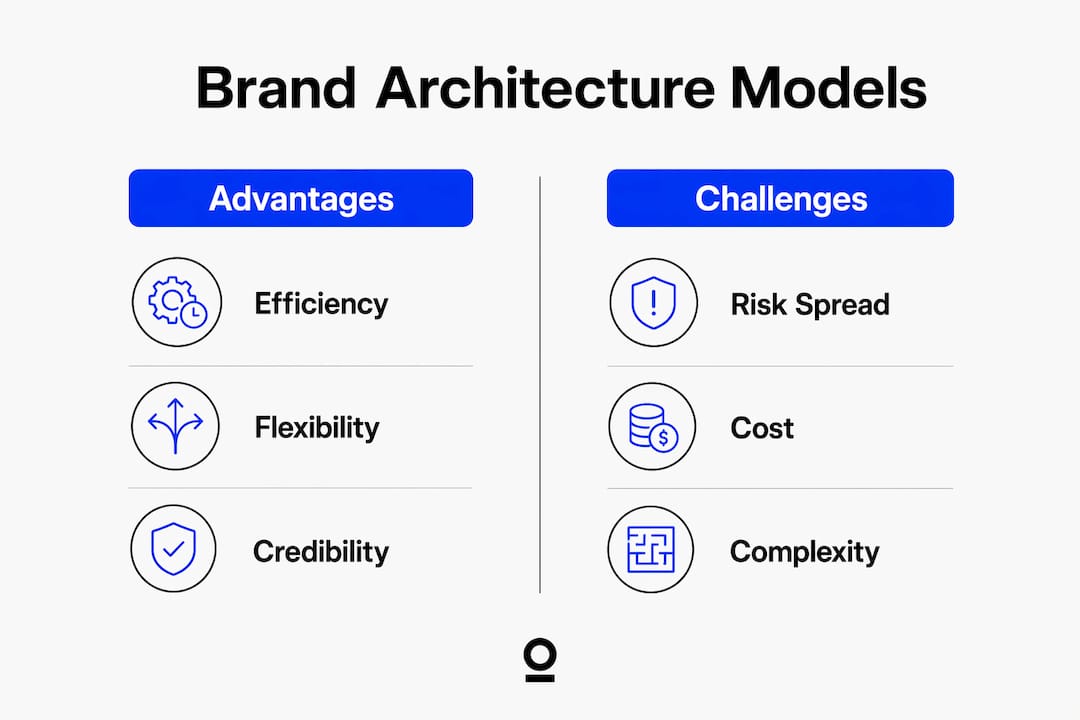
The four brand architecture models: trade-offs, examples, and governance
Branded house
One master brand. Every product or service carries that brand’s name and visual identity. Apple is the clearest example: iPhone, MacBook, Apple Watch, Apple TV — all unmistakably Apple. The master brand does the heavy lifting, and every product launch reinforces it.
Pros: marketing spend is concentrated and efficient; brand equity compounds across the portfolio; customer trust transfers instantly to new products.

Cons: a product failure damages the whole brand; it is harder to target radically different audiences; diversification into unrelated categories feels forced.
When it fits: your master brand is strong, your product range is coherent, and you are not planning to enter markets where the parent brand would feel out of place.
Governance complexity: low to medium. One brand team, one set of guidelines, one visual system.
House of brands
Each brand operates independently. The parent company is invisible to consumers. Mondelēz International owns Cadbury, Oreo, Ritz, and Toblerone, but shoppers do not think “Mondelēz” when they reach for a Dairy Milk. Each brand has its own positioning, its own audience, and its own marketing budget.
Pros: risk is isolated between brands; each brand can be positioned and priced independently; you can target very different audiences without confusing any of them.
Cons: expensive to run — each brand needs its own marketing investment; no equity transfer between brands; governance is complex and requires multiple brand teams.

When it fits: your portfolio spans genuinely different categories or audiences, you have the budget to support each brand independently, or you have grown through acquisition and integration would destroy acquired brand equity.
Governance complexity: high. Multiple brand teams, multiple guidelines, and a holding-company layer that rarely surfaces to consumers.
Endorsed brands
Sub-brands carry their own names and personalities, but the parent brand endorses them, usually through a visual or verbal signal. Toyota does this well: Lexus operates as a premium sub-brand with its own identity, while the Toyota name anchors the mainstream range. The endorsement gives Lexus credibility without forcing it to look like a Toyota.
Pros: sub-brands can differentiate for specific audiences; the parent brand provides a credibility floor; risk is partially isolated.
Cons: the endorsement relationship must be managed carefully or it confuses customers; if the parent brand is weak, the endorsement adds little; visual systems can become cluttered.
When it fits: you are launching into a new segment where your master brand alone would not resonate, but you want to borrow its credibility. Also useful post-acquisition when you want to retain a brand’s equity while signalling group membership.
Governance complexity: medium. You need clear endorsement rules, a defined visual hierarchy, and agreement on when the parent brand appears and how prominently.
Hybrid
Most real-world portfolios are hybrids. Coca-Cola is a good example: the Coca-Cola master brand anchors the core range, but the company also owns brands like Sprite and Fanta that operate with more independence. The hybrid model is a deliberate mix, not a failure to commit. It reflects the reality that organisations grow through acquisition, channel expansion, and diversification, and no single pure model fits everything.
Pros: flexible enough to reflect genuine portfolio complexity; allows different strategies for different markets or channels; pragmatic for businesses that have grown organically.
Cons: without clear governance, it drifts into inconsistency; harder to explain internally and externally; requires more sophisticated brand management capability.
When it fits: your portfolio has genuinely different needs across product lines or markets, and you have the governance infrastructure to manage the complexity deliberately.
Governance complexity: high. Requires a clear map of which model applies to which part of the portfolio, and a central steward to prevent drift.
Comparison at a glance
Dimension | Branded house | House of brands | Endorsed brands | Hybrid |
|---|---|---|---|---|
Best for | Coherent portfolio, strong master brand | Diverse audiences, risk isolation | New segments, post-acquisition | Complex portfolios, M&A growth |
Pros | Efficient spend, equity compounds | Risk isolated, flexible positioning | Credibility transfer, differentiation | Reflects real complexity |
Cons | Product failure hits master brand | Expensive, no equity transfer | Cluttered visuals if poorly managed | Governance-heavy, easy to drift |
Implementation complexity | Low to medium | High | Medium | High |
Commercial implications | Fast new product launches, lower cost | High per-brand cost, strong M&A flexibility | Moderate cost, useful for expansion | Variable; depends on governance quality |
Why your brand architecture matters for growth and commercial value
A clear architecture increases customer clarity, marketing efficiency, and long-term brand value. That is not a soft claim. When customers can navigate your portfolio without confusion, cross-sell rates improve, acquisition costs fall, and brand equity accumulates rather than leaking across disconnected touchpoints.
The commercial consequences are direct:
Customer decision-making: a clear hierarchy tells customers which brand to trust for which need, reducing friction at the point of purchase.
Cross-sell and up-sell: when sub-brands are visibly connected to a trusted parent, customers are more willing to try adjacent products.
Channel strategy: architecture determines how your brand appears in wholesale, DTC, retail, and digital channels. Inconsistency across channels erodes trust.
Acquisition costs: a strong master brand reduces the cost of launching new products because awareness and trust are already banked.
M&A and expansion: a well-documented architecture makes due diligence cleaner, integration decisions faster, and international rollouts more predictable.
Academic research published in the Journal of Brand Management found that UK fashion brands face particular pressure when channel expansion and takeovers create a disconnect between corporate and sub-brand identities. The study proposed a “twin brand architecture” model to reflect this complexity, a signal that even well-established brands need to revisit their structure when the commercial context shifts.
The risk of getting it wrong is not abstract. A misaligned architecture means your marketing budget is working against itself, your sales team cannot tell a coherent story, and customers are left to guess how your products relate to each other.
How do you choose the right brand architecture model?
Start with one diagnostic question: does your master brand have the strength and relevance to carry every product in your portfolio? If yes, a branded house is worth serious consideration. If no, you need to decide how much independence each product or sub-brand genuinely needs.
Work through this checklist:
Market overlap: do your products target the same audience, or genuinely different ones?
Master brand strength: is your parent brand trusted and relevant across all your product categories?
Risk isolation: would a failure in one product line damage your other brands if they shared a name?
Channel differences: do different products live in different retail, digital, or physical environments where a shared identity would feel wrong?
Acquisition or diversification plans: are you likely to acquire brands in the next three years? If so, how will they sit in your structure?
Governance capacity: do you have the team and budget to manage multiple brand identities independently?
Map your answers:
Mostly “same audience, strong master brand, low risk, shared channels, no acquisitions, lean team” → branded house.
Mostly “different audiences, weak master brand relevance, high risk, different channels, acquisitions likely, large team” → house of brands.
Mixed answers with a strong parent brand → endorsed brands.
Mixed answers with genuine portfolio complexity → hybrid.
Pro Tip: Before committing to a full architecture change, pilot the new model with one product line or market. Run it for a defined period, measure customer clarity and marketing efficiency, and use those results to build the business case for a wider rollout.
How to implement your chosen brand architecture
The first governance decision is who owns the architecture. A single steward, whether that is a brand director, a brand committee, or an agency partner, prevents the drift that kills hybrid and endorsed models over time. Without a clear owner, every team makes local decisions that compound into incoherence.
Your first three steps after choosing a model:
Audit your existing brand assets — names, logos, visual systems, domain names, legal registrations, and channel presences.
Define your naming conventions — decide what is allowed (e.g., “Toyota Lexus” vs “Lexus by Toyota” vs “Lexus”) and what is prohibited. Write it down.
Build or update your brand playbook — a single source of truth covering logo usage, colour systems, typography, tone of voice, and endorsement rules.
On visual systems: a branded house needs tight consistency. A house of brands needs separate visual identities that do not bleed into each other. Endorsed and hybrid models need a defined visual hierarchy that signals the relationship without creating clutter. The web design principles that govern digital touchpoints are part of this system, not separate from it.
A realistic phased rollout looks like this:
Discovery (weeks 1–4): stakeholder interviews, brand audit, customer research.
Pilot (weeks 5–12): apply the new architecture to one product line or market. Test naming, visual system, and messaging.
Phased rollout (months 4–12): roll out by channel, market, or product category. Prioritise highest-visibility touchpoints first.
Measurement (ongoing): track brand awareness, customer clarity scores, cross-sell rates, and cost per acquisition.
Do: communicate the change internally before it goes external. Your sales and customer service teams need to understand the logic before customers ask questions.
Don’t: change everything at once. Phased rollouts allow you to catch problems early without betting the whole portfolio on a single launch.
Pro Tip: Your brand playbook is only useful if people can find and use it. Store it in a shared, version-controlled location and assign someone to keep it current. A playbook that lives in a PDF on someone’s desktop is not a governance tool.
Common mistakes and when to review your architecture
The most predictable mistakes are poor stakeholder alignment, inconsistent visual execution, ignoring channel differences, and over-leveraging master brand equity into categories where it does not belong.
Watch for these warning signs:
Customer confusion in research: if focus groups or surveys show customers cannot explain how your brands relate to each other, your architecture is not working.
Poor cross-sell rates: customers who buy one product but never consider another from the same portfolio often do not know the connection exists.
Acquisition integrations failing: when an acquired brand loses equity during integration, the architecture decision was probably wrong or rushed.
Rising cost per acquisition: if each product line is effectively rebuilding awareness from scratch, you are not getting the efficiency a well-structured portfolio should deliver.
Internal confusion: if your own sales team cannot explain your brand structure, your customers certainly cannot.
Review your architecture when:
You complete a merger or acquisition.
You expand into a new channel (e.g., moving from wholesale to direct-to-consumer).
Customer research consistently flags brand confusion.
You enter a new international market where your master brand has no equity.
Your marketing cost per acquisition rises without a clear external cause.
Quick remedial actions: for visual inconsistency, run a brand audit and update the playbook before the next campaign cycle. For stakeholder misalignment, hold a structured workshop with finance, legal, sales, and marketing before any external change. For channel confusion, map every customer touchpoint and identify where the architecture breaks down.
How Brands & Co approaches hybrid portfolio alignment
The clearest outcome Brands & Co delivers for clients is commercial clarity: a brand structure that customers understand, a visual system that holds together across channels, and a strategic rationale that the whole business can get behind.
A typical client situation looks like this: a UK business has grown through a combination of organic product development and one or two acquisitions. The portfolio has three or four distinct offerings, each with its own name and visual identity, but no coherent logic connecting them. Marketing spend is duplicated, the sales team tells different stories, and customers who buy one product have no idea the others exist.
The diagnostic questions Brands & Co uses are the same ones in the decision checklist above: master brand strength, audience overlap, risk profile, channel differences, and governance capacity. From those answers, the architecture recommendation follows. For most UK SMEs and scaleups, the answer is a well-governed hybrid or endorsed model, not a full rebrand to a pure branded house.
Implementation typically covers naming conventions, a visual identity system that reflects the chosen hierarchy, a brand playbook, and a phased rollout plan. The Soul Reformer Club project is one example of how Brands & Co has applied this thinking to a real client portfolio, aligning brand identity with commercial strategy and digital presence.
Key takeaways
The most effective brand architecture is the one that matches your commercial reality, not the one that looks cleanest on a whiteboard.
Point | Details |
|---|---|
Four canonical models | Branded house, house of brands, endorsed brands, and hybrid each suit different portfolio structures and commercial contexts. |
Governance is non-negotiable | Assign a single steward and build a brand playbook before rollout, or any model will drift into inconsistency. |
Review triggers matter | Reassess your architecture after a merger, a major channel expansion, or when customer research flags consistent confusion. |
Pilot before committing | Test the new architecture on one product line first; use the results to build the business case for a wider rollout. |
Brands & Co | Brands & Co helps UK businesses diagnose, design, and implement the right architecture through strategy, visual identity, and a structured rollout plan. |
The trade-offs nobody tells you about
Most guides present brand architecture as a clean decision tree. Pick your model, follow the steps, done. The reality for UK businesses, particularly SMEs and scaleups, is messier and more interesting.
The hybrid model is not a compromise. It is often the most honest reflection of how a business has actually grown. The problem is that most organisations adopt a hybrid structure by accident rather than by design, and that is where the trouble starts. An accidental hybrid looks like a deliberate one from the outside, but internally there are no naming rules, no visual hierarchy, and no one person who owns the architecture. It drifts.
What Brands & Co consistently finds with UK clients is that the architecture conversation surfaces deeper questions: who owns the brand decision, what does the business actually stand for, and which products are genuinely central to the future versus legacy lines that are being kept out of habit. Those are not comfortable questions, but they are the ones that lead to an architecture that holds.
For B2B businesses and scaleups in particular, the endorsed model is often underused. It allows you to build distinct product or service brands that can stand on their own in their respective markets, while the parent brand provides the credibility that shortens sales cycles. That is a real commercial advantage, and it does not require the budget of a full house of brands.
The honest recommendation: do not pick a model because it is what a competitor uses or because it looks tidy. Pick the one that reflects your actual portfolio, your actual governance capacity, and the way your customers actually experience your brands. Then build the playbook and stick to it.
Brands & Co can help you build the right structure
Getting your brand architecture right is one of the highest-leverage decisions a growing business can make. Brands & Co is a UK branding and creative studio with nearly two decades of experience helping SMEs, scaleups, and established businesses design and implement brand structures that actually work in the real world.

The studio offers the full range of services an architecture project needs: strategic diagnostics, naming conventions, visual identity systems, brand playbooks, website design, and phased rollout support. Whether you are integrating an acquisition, launching a new product line, or untangling a portfolio that has grown without a clear structure, Brands & Co works through the problem with you rather than handing you a generic framework. For a concrete example of the work, the Transcend With Laura project shows how strategic identity and site work come together in practice.
If you are ready to get clear on your brand structure, get in touch with Brands & Co to start the conversation.
Useful sources and further reading
A proposed brand architecture model for UK fashion brands, Journal of Brand Management, Springer Nature — academic research on channel expansion, takeovers, and hybrid architecture in a UK context.
How to develop brand architecture, HubSpot — practical guide covering the four models with definitions, pros/cons, and examples.
The Brand Report Card, Harvard Business Review — Aaker and Joachimsthaler’s foundational framework for brand relationship spectrums.
Brand architecture, Wikipedia — a useful reference overview of terminology and model definitions.
Brand environment design for immersive experiences — partner perspective on how architecture decisions play out in physical and retail environments.
Brand storytelling and experiential campaigns — partner perspective on how architecture shapes customer experience and messaging.
Brands & Co studio and services — agency home page for an overview of branding, strategy, and design services.
Logo design cost UK, Brands & Co — background on brand identity investment and budgeting for UK businesses.