Mailchimp vs Klaviyo: the UK agency guide (2026)
Discover how Mailchimp vs Klaviyo stacks up for ecommerce growth. Uncover which platform suits your agency's needs best in 2026.

Mailchimp vs Klaviyo: the UK agency guide (2026)
Klaviyo wins for data-driven ecommerce growth. Mailchimp wins for fast, design-led newsletters and agencies that need speed. That is the honest verdict, and everything else in this comparison unpacks why.
The two primary decision axes are:
Data depth vs delivery speed. Klaviyo’s behavioural segmentation and order-level attribution suit ecommerce brands where revenue proof matters. Mailchimp’s drag-and-drop editor and Creative Assistant suit agencies turning around polished campaigns quickly.
Ecommerce integration vs multi-client convenience. Klaviyo’s Shopify and WooCommerce sync is deeper. Mailchimp’s broad template library and faster onboarding suit agencies managing many small accounts.
The most revealing test is not a feature list. Run the same welcome sequence in both platforms on a real client account and the workflow fit becomes obvious within a week.
Table of Contents
How do Mailchimp and Klaviyo compare side by side?
How does Mailchimp vs Klaviyo pricing actually work?
How deep do automations and segmentation go?
How do Shopify and WooCommerce integrations compare?
What do reporting and A/B testing look like for agencies?
What about deliverability and UK GDPR compliance?
How do agency workflows and migration actually work?
Which platform fits your client’s situation?
Key takeaways
The honest agency view
Brands & Co can handle the platform decision for you
FAQ
Useful sources
How do Mailchimp and Klaviyo compare side by side?
Dimension | Klaviyo | Mailchimp |
|---|---|---|
Best for | Ecommerce brands, lifecycle revenue | Fast newsletters, design-first agencies |
Pricing model | Active profiles + channel add-ons | Contact-count tiers |
Ease of use | Steeper learning curve | Fast to learn, polished UI |
Segmentation | Behavioural, predictive, order-based | Filter and tag-based |
Automations | Multi-channel branching flows | Linear journeys, campaign-centric |
Deep historical sync + onsite tracking | Standard integration | |
WooCommerce | Native plugin, purchase history sync | Plugin available |
Revenue attribution | Order-level, native dashboards | Basic click-based attribution |
Deliverability | Shared + dedicated IP options | Shared infrastructure |
Agency / multi-account | Partner programme, sub-accounts | Agency accounts available |
GDPR / UK data | Data processing agreement available | DPA available |
Migration effort | Medium to high | Low to medium |
Three practical differences agencies should weigh:
Klaviyo’s revenue attribution dashboards let you show clients a direct link between email flows and orders, which shortens retainer-renewal conversations considerably.
Mailchimp’s Creative Assistant generates on-brand header images from a logo and colour palette, cutting creative production time for time-sensitive briefs.
SMS availability varies by country on both platforms; UK agencies should confirm channel availability and cost before promising multi-channel delivery to clients.
How does Mailchimp vs Klaviyo pricing actually work?
Pricing shape matters more than list size alone, and the two models behave very differently as client lists grow.
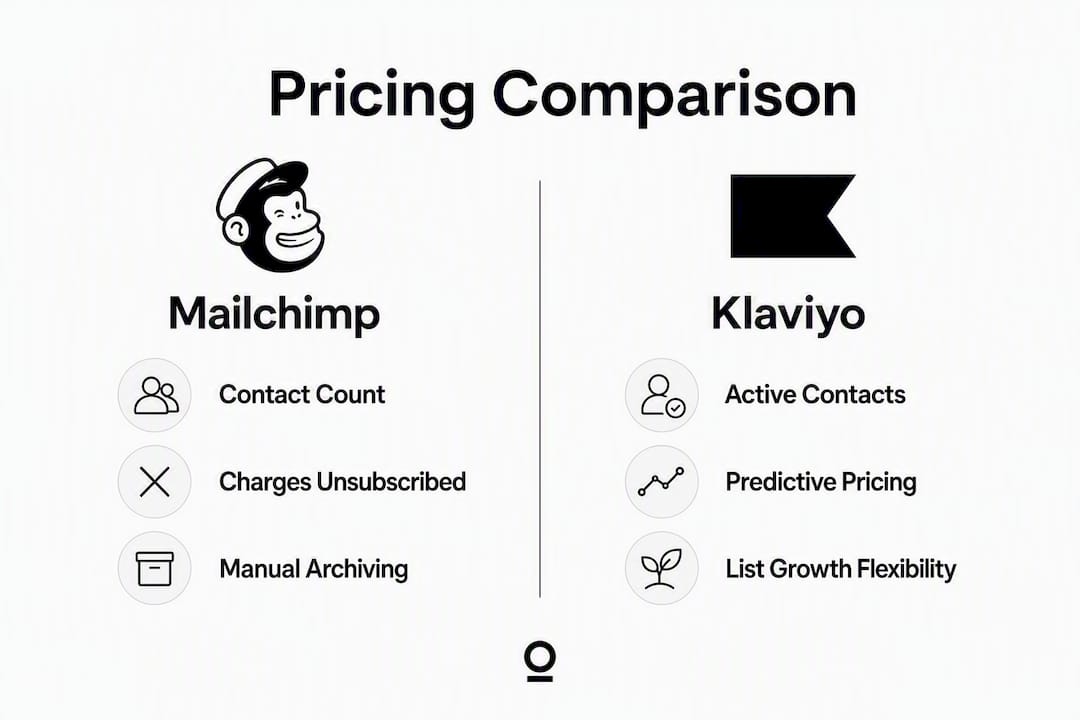
Mailchimp bills on total contact count, including unsubscribed addresses unless you manually archive them. That billing quirk inflates agency costs on accounts that have been running for a while, because lapsed subscribers still count toward your plan tier. Paid plans start from around £10 per month for small lists, scaling with contact volume.
Klaviyo bills on active profiles and separates email from SMS as a channel add-on. Where clients have large lists but send infrequently, profile-based pricing can be materially cheaper than a contact-count model. The predictability is better once you understand what counts as an active profile.
Key billing considerations for agencies:
Audit every client list before onboarding. Archive unsubscribed contacts in Mailchimp accounts to avoid paying for dead records.
For Klaviyo, map which contacts are genuinely active before migration; suppressed profiles do not count toward billing.
SMS in the UK is a paid add-on on both platforms. Build that cost into client proposals before committing to multi-channel campaigns.
Multi-client roll-ups on Mailchimp can create billing surprises if account hygiene is inconsistent across the portfolio.
How deep do automations and segmentation go?
This is where the platforms genuinely diverge, and where your client’s business model should drive the decision.

Klaviyo’s segmentation is built on behaviour, order history, and predictive signals such as predicted lifetime value and churn risk. You can build a segment of customers who bought a specific product category, have not purchased in 90 days, and are predicted to spend above a threshold. That granularity powers lifecycle flows that actually move revenue.
Mailchimp uses filter and tag-based segments. They are quicker to set up and sufficient for most newsletter and content-led workflows, but they do not reach the same depth for ecommerce triggers.
On automations, Klaviyo supports multi-channel branching flows with conditional splits, time delays, and A/B path testing. Mailchimp’s automation builder is more linear and campaign-centric, which suits agencies that need to ship quickly rather than architect complex journeys. For customer journey mapping across a full ecommerce lifecycle, Klaviyo gives you more to work with.
Pro Tip: Start with three flows in Klaviyo before judging the platform: welcome series, abandoned cart, and post-purchase. Those three alone will surface whether the data mapping and attribution are working correctly, and they represent the highest-ROI automations for most ecommerce clients.
For Mailchimp, build the welcome sequence and one re-engagement flow first. You will know within two weeks whether the template speed and reporting depth meet your client’s expectations.
How do Shopify and WooCommerce integrations compare?
Klaviyo’s Shopify integration pulls years of historical order and product data into customer profiles, supports onsite tracking for browse-abandonment triggers, and handles Shopify Markets localisation for brands selling across multiple regions. That depth is what makes lifecycle segmentation genuinely useful rather than theoretical.
Mailchimp connects to Shopify via a third-party integration following a period when the native integration was removed. It works, but the historical data sync is shallower and onsite tracking requires additional configuration.
For WooCommerce, both platforms offer plugins. Klaviyo’s plugin syncs purchase history and product data into profiles for segmentation and flow triggers. Mailchimp’s WooCommerce plugin covers the basics and suits stores that prioritise campaign speed over deep behavioural data.
From an agency reporting perspective, Klaviyo’s order-level revenue attribution means you can show a client exactly which flows generated which orders. Prebuilt ecommerce flow templates in Klaviyo (abandoned cart, browse abandonment, win-back) reduce implementation hours for Shopify accounts, which often justifies the higher platform cost for those clients.
What do reporting and A/B testing look like for agencies?
Klaviyo provides revenue dashboards at the flow and campaign level, cohort reports, and industry benchmarking where available. Attribution windows are configurable, which matters when you are separating email-driven revenue from organic traffic in client reports.
Mailchimp offers click-based attribution, open and click reporting, and A/B testing on subject lines, content, and send times. Advanced reporting, including multivariate testing, is locked to higher-tier paid plans. For agencies presenting brand tracking and campaign impact to clients, Mailchimp’s dashboards are clean and easy to screenshot, but they do not tell the revenue story that Klaviyo does.
Attribution windows on both platforms can overcount revenue if not configured carefully. An email sent on Monday and an organic search on Wednesday can both claim the same purchase depending on your window settings.
What about deliverability and UK GDPR compliance?
Both platforms maintain strong sending reputations on shared infrastructure. Klaviyo offers dedicated IP options for high-volume senders, which gives agencies more control over sending reputation for large ecommerce clients.
Pro Tip: Monitor deliverability with a tool like Google Postmaster Tools or MXToolbox alongside your platform’s native reporting. Platform dashboards show opens and clicks; external tools show whether you are landing in the inbox at all.
On UK GDPR, both platforms offer data processing agreements. Data may be stored on US-based servers, so agencies working with regulated clients should review the DPA terms and confirm standard contractual clauses are in place. Double opt-in is available on both platforms and is the safest default for UK list building post-Brexit.
Consent records matter. Whichever platform you use, store the source and timestamp of consent outside the platform itself. If you ever migrate, that data travels with you.
How do agency workflows and migration actually work?
Both platforms offer agency or partner programmes. Klaviyo’s partner programme provides sub-account management and co-marketing support. Mailchimp’s agency accounts allow multi-client management from a single login.
Migration from Mailchimp to Klaviyo is the more common direction. A practical checklist for a small ecommerce client:
Export and clean the contact list; archive unsubscribed records before the final export.
Map custom fields and tags to Klaviyo profile properties.
Rebuild key flows: welcome series, abandoned cart, post-purchase.
Implement onsite tracking (Klaviyo’s JavaScript snippet or Shopify app).
Test revenue attribution on a live order before going live.
Run the welcome sequence in both platforms simultaneously for two weeks to compare reporting.
Suppress the old list in Mailchimp once attribution is confirmed in Klaviyo.
A realistic timeline for a small ecommerce account is four to six weeks, with the main cost drivers being developer time for tracking implementation and QA on flow logic. For a marketing automation checklist covering the broader SMB migration steps, that resource is worth bookmarking alongside this guide.
Which platform fits your client’s situation?
Pure ecommerce store on Shopify or WooCommerce. Klaviyo. The integration depth and revenue attribution justify the setup time.
Content-led publisher or newsletter brand. Mailchimp. Fast templates, clean editor, no need for order-level data.
Local services franchise with multiple locations. Mailchimp for speed and simplicity; Klaviyo if the franchise tracks customer purchases and wants lifecycle triggers.
Multi-client agency with many small lists. Mailchimp for operational efficiency. Audit contact lists regularly to avoid billing inflation.
Growth-stage ecommerce brand scaling past £500k revenue. Klaviyo. Predictive segmentation and attribution pay off at this stage.
Key takeaways
Klaviyo is the stronger choice for ecommerce brands that need behavioural segmentation and revenue attribution; Mailchimp is faster to deploy and better suited to design-led, newsletter-first workflows.
Point | Details |
|---|---|
Platform verdict | Klaviyo for ecommerce revenue; Mailchimp for fast, design-led campaigns and multi-client agency speed. |
Pricing watch | Mailchimp bills on total contacts including unsubscribed; archive lapsed records before onboarding to avoid inflated costs. |
Migration timeline | A small ecommerce account typically takes four to six weeks to migrate fully, with tracking implementation as the main cost driver. |
Agency test | Run the same welcome sequence in both platforms on a real client account; reporting fit becomes clear within two weeks. |
Brands & Co | Brands & Co can run the platform pilot, rebuild automations, and manage migration so your team does not carry the delivery risk. |
The honest agency view
Most platform debates focus on features. The real question is whether the platform’s reporting language matches what your client actually cares about.
For ecommerce clients, that language is revenue. Klaviyo speaks it natively. For content brands and service businesses, the language is engagement and list growth, and Mailchimp handles that conversation well without the configuration overhead.
At Brands & Co, the typical recommendation follows the client’s business model, not the platform’s marketing. When a client’s primary goal is measurable email revenue from an ecommerce store, Klaviyo is the shortlist. When speed, design quality, and multi-client management matter more, Mailchimp earns its place.
The welcome-sequence test is not a gimmick. Build the same three-email sequence in both platforms, send to a real segment, and look at what the reporting tells you. That single exercise has settled more platform debates than any feature comparison.
Brands & Co can handle the platform decision for you
If you would rather spend your time on strategy than on data mapping and flow rebuilds, that is exactly what Brands & Co is built for. The platforms are tools. The thinking behind them is where the value lives.

Brands & Co runs platform audits, builds the welcome-sequence pilot in both tools, and delivers a clear migration plan with automations ready to go live. No guesswork, no half-built flows, no billing surprises. Whether you are moving a Shopify store from Mailchimp to Klaviyo or setting up lifecycle automations from scratch, the process is handled end to end.
If you want to see what that looks like in practice, the Soul Reformer Club project shows how Brands & Co approaches brand and digital delivery for clients who need things done properly. Or, if you need a campaign-ready site alongside your platform migration, the five-day website package gets you live fast.
Get in touch at brandsand.co to talk through your client’s setup.
FAQ
Is Klaviyo or Mailchimp better for Shopify stores?
Klaviyo is the stronger choice for Shopify. Its integration syncs historical order data and supports onsite tracking for behavioural triggers, enabling deeper lifecycle automation than Mailchimp’s Shopify connection.
Does Mailchimp charge for unsubscribed contacts?
Yes. Mailchimp’s billing counts unsubscribed contacts toward your plan limit unless they are manually archived. Agencies should audit and archive lapsed records before onboarding a client account to avoid inflated costs.
How long does migrating from Mailchimp to Klaviyo take?
A small ecommerce account typically takes four to six weeks. The main time cost is implementing onsite tracking, rebuilding key flows, and confirming revenue attribution on live orders before switching fully.
Which platform is easier for agencies managing multiple clients?
Mailchimp is generally faster to manage across multiple small accounts, with a cleaner onboarding process and quicker campaign turnaround. Klaviyo’s partner programme suits agencies focused on ecommerce clients where revenue attribution justifies the setup overhead.
Are both platforms compliant with UK GDPR?
Both offer data processing agreements and support double opt-in. Data may be stored on US-based servers, so agencies with regulated clients should review DPA terms and confirm standard contractual clauses are in place.
Useful sources
Klaviyo vs Mailchimp for Ecommerce | Sendfluence — UK-focused comparison covering ecommerce integration depth and agency use cases.
Klaviyo vs. Mailchimp: Comparing Email Marketing Software | Shopify UK — Shopify’s own breakdown of integration depth, pricing, and automation; supports the ecommerce integration section.
Klaviyo vs. Mailchimp: I Tested Both Email Platforms for 2026 | G2 — Hands-on platform test covering segmentation, ease of use, and automation builders; supports the agency test recommendation.
Best Email Marketing Software for Agencies | Open Rate Club — Agency-specific perspective on platform fit, revenue attribution, and the welcome-sequence pilot method; primary source for the agency test recommendation.
Brevo vs Mailchimp 2026 | Marc Andrews — Covers Mailchimp’s contact-count billing model and how pricing shape affects UK small businesses.
Best Email Marketing Platforms for UK Businesses 2026 | Marc Andrews — UK market pricing context and GDPR tool ratings across platforms.
Marketing Automation Checklist for SMBs | Babylon Love Growth — Step-by-step automation checklist useful alongside the migration section.